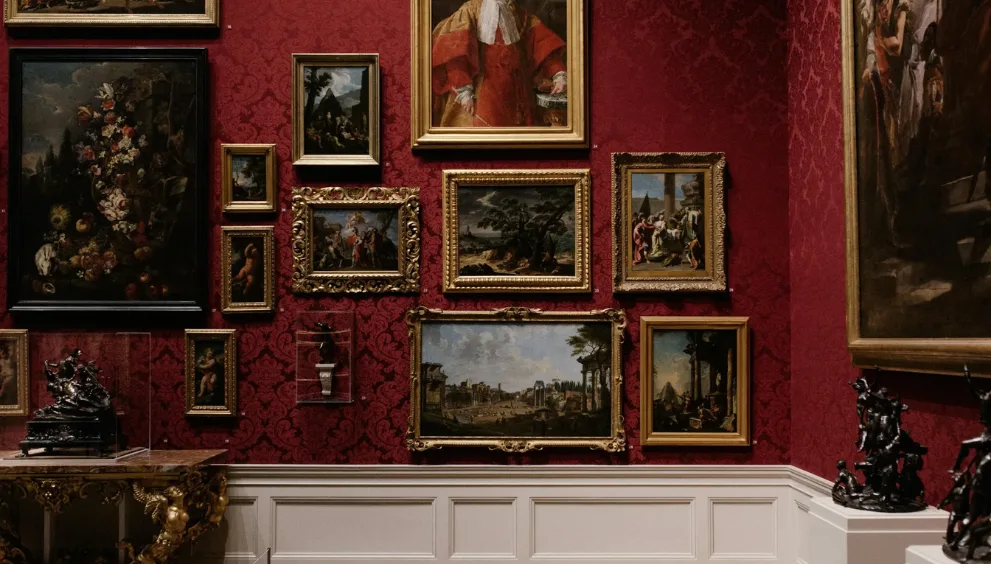
In the elevated world of the ultra-wealthy, luxury has grown quieter, deeper and more layered. Logos are disappearing, replaced by brushstrokes. Art has become the new armor. The contemporary elite does not proclaim triumph using signs of velocity or glitz, but a deliberate, intellectual type of silence.
Consider entering a Tokyo penthouse where it is quiet, and not a revving engine that sounds, but just soft light on a Yayoi Kusama pumpkin in a glass case, slowly throwing hypnotic shadows in the light.
Or you have fawed up in a townhouse in London, Mayfair, and under coffered ceilings on which hung oil portraits, there is a feral and ironic Banksy work. It is a Basquiat that sings in color and commentary of the floor-to-ceiling windows of Saint-Tropez, and a reflection of sea and soul.
These are not simply homes. They are private home art galleries. They are shrines to perspective. And the ultimate trophy is no longer a possession, but the story you choose to live with on your walls.
1. From Trophy Rooms to Thought Pieces
Once, wealth was measured in square footage, rare whiskey, or vintage car collections. Trophy rooms were evidently masculine, maximalist, built to impress. But today’s Ultra-High-Net-Worth Individuals, in short UHNWIs, are curating something subtler.
They want homes that feel like personal museums. A quiet shift is underway, from collecting dominance to collecting dialogue. Where once a wall might have held ten gleaming timepieces, now hangs a single, brooding Rothko print. In place of a mahogany gun rack, a meditative Kusama sculpture stands in a light well, inviting reflection over reaction.
These works don’t shout wealth, but they suggest an alignment with beauty, history, even rebellion. It’s no longer about what you own, but why you chose it. In these new trophy rooms, each piece is a declaration of taste, curiosity, and most importantly, intellect.
2. Why Does Basquiat Live in the Living Room?
To live with a Basquiat is to live with electricity. His work doesn’t politely hang, it demands attention with its wild linework, chaotic symbols, and biting cultural critique. Basquiat painted with urgency, and you can still feel it in his work.
UHNWIs aren’t just locking him away in vaults anymore; they’re building entire rooms around him. In a brownstone in Brooklyn, a young art-tech billionaire displays ‘Boy and Dog’ in a Johnnypump opposite a modular, low-slung conversation pit. Every dinner party begins there.
Guests sit near the painting, drinks in hand, often falling into debate about its meaning, it’s madness. For many collectors, a Basquiat is a mirror. Flawed, bold and unrelenting. His art not just resonates with financial value, but with emotional risk as well. To place him in a living room is to say, “Here, in the most lived-in part of my life, is the most unfiltered part of myself.”
3. Banksy in the Study: The Politics of Placement
Banksy is a contradiction in a frame, graffiti turned gallery darling. There is something subversive in his disrespectful images and his non-identified face that makes the work threatening even on the walls of a museum in the villa of a billionaire.
And that is what makes it irresistible. It is a premeditated tension created when Banksy hangs in a study or a hallway of a domestic house. It asks questions of the space, the people in it, and even of the collectors themselves. In a Geneva lakehouse, one homeowner has ‘Love is in the Air’ hanging above a 19th-century fireplace.
At first glance, we can see the rawness of Banksy clashing with old-world polish. But on second glance, it fits, rebellion nestled into refinement. In another home in Aspen, a guest bathroom holds a smaller Banksy piece with subtle lighting, a cracked tile preserved where the stencil was first placed. It’s the ultimate inside joke, political art displayed in a place of privacy.
These placements aren’t random. They’re calculated contradictions. They are a way for UHNWIs to signal awareness, irony, and intelligence all at once.
4. The Architecture of Display: Homes Built Around Masterpieces
The art no longer adjusts to the room. The room adjusts to the art. Designing around art has become a signature move of the cultural elite. Architects are collaborating with curators to design walls devoid of sunlight, air conditioning that defends canvas and ceiling heights that can accommodate a 10-foot Anselm Kiefer.
The engineering of these houses is as accurate as that of a private museum, and lived in as a sanctuary. In Dubai, a glass staircase spirals around a suspended Kusama orb, casting dotted light across all three levels of the home. In Venice, a collector modified their palazzo’s canalside salon to accommodate a giant Cy Twombly.
Floors reinforced, color palette subdued and air filtered. The result? A home where art doesn’t just decorate, it dictates. The environment becomes an ecosystem of intentionality. Every door frame, every corner, every shadow is curated for reverence.
5. Vernissages Behind Closed Doors: The New Social Scene
Public art events are becoming passé. True cachet lies in the private vernissage. An evening where art, wine, and ideas flow in equal measure behind closed doors. In Paris, a financier recently hosted a candlelit dinner where each course was inspired by a different Kusama motif.
In L.A., a tech heiress revealed a newly acquired Banksy during dessert, hidden behind a mechanical wall that rotated with the push of a remote. Guests weren’t influencers or press; they were poets, architects, and one retired ballerina. These events aren’t about showing off. They’re about telling a story.
About crafting an experience so intimate that it becomes mythic. The art is the excuse, but the intent is connection. And the collector is the curator, and the host the oracle in this world.
In the current age of low-profile wealth and understated opulence, the final status symbol may not be possessing rare items, but having them at the right place, the right time, with all the right people. These private galleries are not merely statements of affluence, but of perception of the world. The owner of a house is no longer merely a collector. He is a narrator, a sage, a contemporary curator with muttering walls, but not full of money, but full of sense.
Quiet luxury is discriminatory. It is not the question of gathering, it is the question of expressing. In this landscape, UHNWIs are no longer interested in impressing with what they purchase, but framing it, preserving it, sharing it, privately. A Basquiat in the breakfast room.
A Kusama glowing softly in a stairwell. A Banksy tucked behind a sliding panel. These aren’t ornaments. They’re reflections. In 2025, the new trophy isn’t loud, fast, or gold-plated. It’s thoughtful, placed with care, and it’s lived daily. And most of all, it means something.